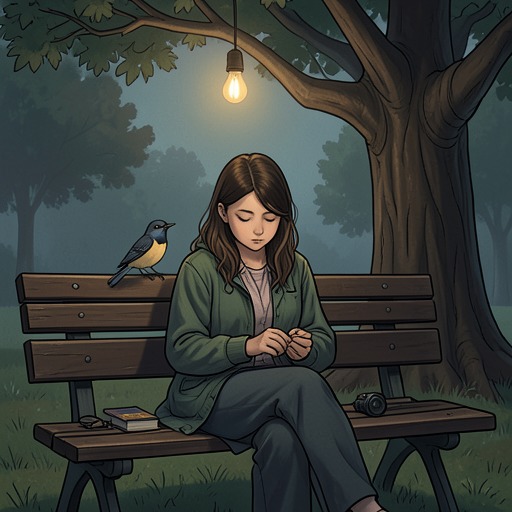
Man can do what he wills, but he cannot will what he wills
Turtles All the Way Down“Man can do what he wills, but he cannot will what he wills” is the epigraph to Turtles All the Way Down, attributed to Arthur Schopenhauer. Its distinction between doing and willing establishes a central tension: action may be possible even when the desires and thoughts that precede it do not feel chosen. The novel returns to that tension through Aza Holmes’s experience of circumstance, mental illness, and the uncertain boundary between a person and the thoughts passing through her.
Epigraph and Core Distinction
The sentence is brief, but its two clauses pull in different directions. The first allows that a person can act; the second questions whether the person can choose what they want in the first place. The epigraph therefore does not simply declare that human beings have no agency. It places agency under pressure by asking what control means when the source of a will is not itself under conscious control.
That distinction also gives the line a particular role as a frame for the novel. It prepares readers to encounter choices that are real but constrained: a person may respond to a situation without having selected the thoughts, bodily states, or conditions that helped produce the response. The epigraph’s concise formulation becomes a lens for reading both Aza’s reflections and the book’s repeated images of forces acting upon her.
Circumstance and the Story of a Life
The opening chapter makes the problem concrete through an ordinary school routine. Aza describes attending White River High School in Indianapolis and eating lunch between 12:37 and 1:14 P.M. She imagines that a different lunch period, or a different conversation among her tablemates on a September day, could have led to a different end—or at least a different middle. The apparent smallness of the circumstance sharpens the point: a life’s direction can depend on conditions the person did not arrange.
The bell makes the difference between apparent choice and its limits especially vivid. Aza observes that someone may think they choose to go to lunch when the bell rings, but “the bell decides.” Her accompanying image reverses the usual idea of authorship: a person may feel like the painter while being the canvas. The passage links the epigraph’s distinction between action and willing to a broader uncertainty about who authors a life. Aza’s account treats the self not as an independent origin of every choice, but as someone shaped by forces that are difficult even to identify.
Thought, Body, and Identity
Aza applies the same question to her inner life. She says she cannot choose her thoughts and therefore doubts whether they are truly hers; she also points to bodily processes and circumstances she does not decide, including sweating and illness. In this account, the problem is not only whether she can act, but whether there is a stable self beneath changing conditions. She wonders whether the same person persists across differences in money, romantic relationships, or school, or whether she is only a set of circumstances.
Her uncertainty appears again in her fear that medication might change her deepest self. Aza describes the possibility that a pill could alter the “way-down” part of her as unsettling, even though she wants relief from what she calls a demon. The conflict gives the epigraph an intimate, practical dimension: treatment may offer a way to act against suffering, while also raising questions about which version of the self is being changed and who gets to define it. The passage does not resolve those questions by treating either the illness or the person as a simple, separate thing.
Limits of the Epigraph
Aza’s reading of a William James maxim about choosing one thought over another makes the conflict explicit. She cannot accept the claim as a description of her own experience: she says that she can no more choose her thoughts than choose her name. The comparison makes involuntary thought feel as fundamental to her as an identity she did not select.
A therapeutic response offers a distinction rather than a claim of total control: “Thoughts are only thoughts. They are not you.” That counsel challenges Aza’s tendency to identify herself completely with what her mind produces, without demonstrating that she can choose which thoughts arrive. In this way, the novel places the epigraph beside a possible form of agency that does not depend on commanding thought itself: a person’s thoughts may be unchosen without exhausting what that person is. The line remains a governing question, but the story complicates any conclusion that constraint makes the self unreal or leaves no room for action.